

Dr Moot Docs
Get a second AI opinion. Learn how Dr Moot's model panels work, how to run your first deliberation, and how to configure the roster for your team.
A single model's first draft is a guess with good grammar. Dr Moot treats important questions the way people do: it convenes more than one model, has them draft, critique, and revise each other's work, and gives you both the conclusion and the deliberation that produced it — so you can see where the models agreed, where they fought, and how confident the panel really is.
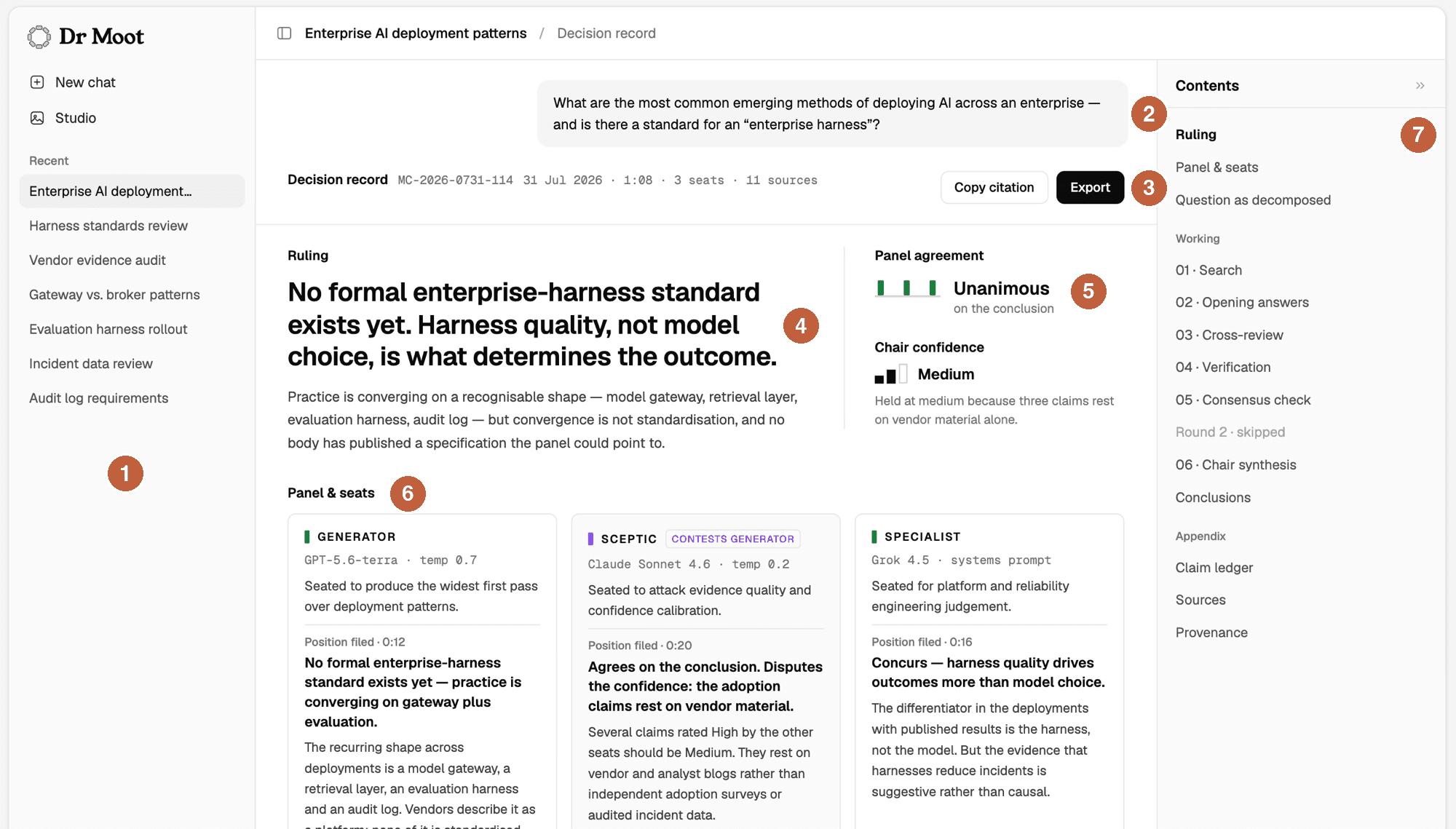
- History — every conversation is saved and reopens with its full decision record.
- The question the panel was asked, exactly as you asked it.
- Record header — citation id, date, seat and source counts, with Copy citation and Export.
- Ruling — the panel's conclusion, stated once, with the reasoning summarised beneath it.
- Panel agreement & Chair confidence — including why confidence was held where it was.
- Panel & seats — who held each seat, why it was seated, and the position it filed.
- Contents — the record's working, phase by phase, with the claim ledger, sources, and provenance in the appendix.
Find your way
Getting started
The Lab, the history sidebar, and the settings overlay — everything you touch, on one page.
Your first question
A five-minute walkthrough from blank chat to inspected answer.
Deliberation modes
Relay, Debate, Moot, and Auto — what each one does and when to reach for it.
Attachments & web search
Give the panel your documents, or let it gather live evidence from the web.
Results & history
Read verdicts, confidence levels, and dissent — and manage saved conversations.
Settings
Review style, personal model overrides, notifications, billing, and usage.
Administration
Manage users and organizations, and run the shared model roster.
Plans & limits
What Light and Pro include, how token budgets work, and what happens at the limit.
The ideas behind Dr Moot
Deliberation, not generation
Every run is a structured conversation between models with assigned jobs — drafter, critic, fact-checker, adjudicator. The disagreement between them is the product: it surfaces the weaknesses a single answer would have hidden.
Four shapes of deliberation
- Relay — one model drafts, another critiques, the first revises, an adjudicator decides. Fast.
- Debate — two models argue over up to three rounds, then an adjudicator rules.
- Moot — a four-seat panel: Generator, Sceptic, Specialist, and a Chair who delivers a verdict with a confidence level.
- Auto — the default. A router model picks the cheapest shape that will answer well, and flags high-stakes questions for verification.
Nothing is a black box
Every intermediate step — drafts, critiques, revisions, web-search evidence, verification, the Chair's verdict — streams live while the run happens and stays attached to the answer afterwards. If the answer matters, read the dissent before you act on the conclusion.
One roster, shared defaults, personal overrides
Admins curate the pool of models and assign a default model to every seat. You can pin your own models per seat in settings; anything you leave on the system default keeps following admin changes automatically.